
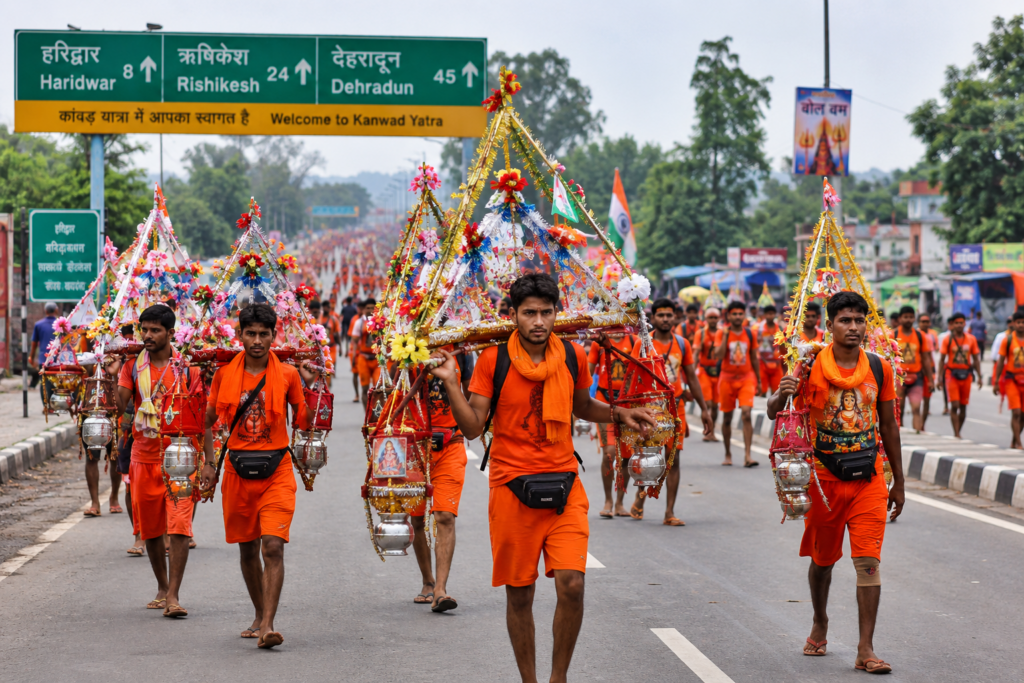
Kanwar Yatra 2026: Important Travel Guide for Uttarakhand
The Kanwar Yatra 2026 will begin on 30 July 2026, the first day of Sawan, and reach its peak on Sawan Shivratri, 11 August 2026. During this period, millions of devotees will travel towards sacred destinations to collect and carry holy Ganga water for jalabhishek.
For tourists travelling from Delhi-NCR towards Haridwar, Rishikesh, Dehradun or Mussoorie, the biggest challenge will not be the pilgrimage itself but the traffic diversions, road closures and massive pedestrian movement.
The simplest travel rule:
Avoid the Haridwar corridor between 7 and 11 August.
For a smoother journey, travel before 30 July or after 13 August, or choose the train, flight or an alternate road route.
Kanwar Yatra 2026 at a Glance
| Key Information | Details |
|---|---|
| Yatra begins | 30 July 2026, Thursday |
| Peak day | 11 August 2026, Sawan Shivratri |
| Sawan ends | 28 August 2026 |
| Most difficult travel period | 1–11 August |
| Worst days for road travel | 7–11 August |
| Best tourist window | Before 30 July or after 13 August |
| Main affected corridor | Delhi–Meerut–Muzaffarnagar–Roorkee–Haridwar |
| Main highway | NH-34, formerly NH-58 |
| Nearest major airport | Jolly Grant Airport, Dehradun |
| Nearest railway stations | Haridwar, Yog Nagari Rishikesh and Dehradun |
When Does Kanwar Yatra 2026 Start and End?
The Kanwar Yatra begins on Thursday, 30 July 2026, marking the beginning of Sawan.
The most important date for travellers is Tuesday, 11 August 2026, Sawan Shivratri. This is when many kanwariyas perform jalabhishek, offering Ganga water to Lord Shiva.
Although the pilgrimage reaches its peak on 11 August, pilgrim movement continues during the wider Sawan period until 28 August.
For tourists, remember these three dates:
30 July → Yatra begins
11 August → Peak crowd and jalabhishek
13 August onward → Crowds begin to reduce
The 10–12 days before Sawan Shivratri are particularly important for anyone planning a road trip through Haridwar.
Important Sawan 2026 Dates
| Date | Event | Travel Impact |
|---|---|---|
| 30 July | Sawan begins / Kanwar Yatra starts | Pilgrim movement increases |
| 3 August | First Sawan Somwar | Additional crowds |
| 10 August | Second Sawan Somwar | Very heavy movement |
| 11 August | Sawan Shivratri | Peak crowds and traffic |
| 13 August onward | Pilgrims begin dispersing | Roads gradually improve |
| 28 August | Sawan ends | Conditions return towards normal |
Quick Planning Tip
If your trip is flexible, do not plan your leisure drive through Haridwar on 10 or 11 August. Waiting a few days can make a significant difference.
What Is the Kanwar Yatra?
The Kanwar Yatra, also known as Kanwad Yatra, is an annual pilgrimage undertaken by devotees of Lord Shiva, popularly known as kanwariyas.
During the pilgrimage:
- Devotees travel to sacred river destinations.
- They collect holy Ganga water.
- The water is carried in decorated pots placed on a kanwar.
- Many pilgrims walk barefoot, often wearing saffron clothing.
- The collected Ganga water is later offered to a Shivling, particularly on Sawan Shivratri.
Some pilgrims also travel by bicycle, motorcycle or specially decorated vehicles.
Why Does the Kanwar Yatra Affect Traffic?
The sheer scale of the pilgrimage makes traffic management essential.
Haridwar, particularly Har Ki Pauri, is one of the most important Ganga-water collection points. Consequently, thousands of pilgrims travel through the roads connecting Delhi-NCR with Haridwar.
Other important pilgrimage sources mentioned in the supplied material include:
- Gaumukh
- Gangotri
- Neelkanth Mahadev near Rishikesh
- Sultanganj in Bihar
The source notes that in 2025, Haridwar received an estimated 4+ crore pilgrims over roughly 15 days, with around 56 lakh pilgrims leaving during the final 24 hours.
Such numbers explain why authorities need to introduce large-scale traffic restrictions.
The Main Kanwar Route
For travellers from Delhi-NCR, the most important corridor to watch is:
Delhi/Ghaziabad → Meerut → Muzaffarnagar → Roorkee → Haridwar
This route follows NH-34, formerly NH-58, and carries a major share of Kanwar traffic.
Unfortunately for tourists, it is also one of the most commonly used routes for reaching Uttarakhand.
Roads and Areas Likely to Experience Heavy Traffic
| Road / Area | Expected Situation |
|---|---|
| NH-34 / former NH-58 | Main Kanwar corridor; major restrictions |
| Delhi–Meerut Expressway | Heavy traffic management |
| Ganganahar Patri | Used as a dedicated Kanwar route |
| Pipeline Marg | Restrictions near Haridwar |
| Haridwar approaches | Pedestrian movement and vehicle controls |
| Rishikesh approaches | Traffic restrictions near important areas |
Important Advice
If your normal journey to Haridwar, Rishikesh or Dehradun takes you through Meerut and Muzaffarnagar, be prepared for diversions or closures, particularly during the peak period.
Kanwar Yatra 2026: Traffic Diversions and Road Closures
The supplied material notes that, as of 1 July 2026, the official 2026 diversion orders had not yet been published by UP and Uttarakhand police.
Therefore, the following should be treated as a planning framework rather than confirmed 2026 closure timings. Exact restrictions should be checked closer to the journey.
| Expected Restriction | Approx. Timing | Main Impact |
|---|---|---|
| Heavy-vehicle restrictions on NH-34, Kanwar Marg, Pipeline Marg & DME | 10–14 days before Shivratri | Trucks and buses |
| Meerut diversions | Around 1–2 weeks before peak | Delhi–Haridwar travellers |
| Ghaziabad / Delhi–Meerut Expressway diversions | Peak window | NCR travellers |
| Delhi–Dehradun Expressway restrictions | Peak days | Expressway users |
| DJ / music-truck regulations | Throughout yatra | Road users and pilgrims |
General traffic between Delhi and Haridwar may be redirected towards NH-9 and the Eastern Peripheral Expressway.
The source also refers to the traffic arrangements implemented during the previous year’s yatra as an indication of what travellers might encounter.
What About the New Delhi–Dehradun Expressway?
The Delhi–Dehradun Expressway offers a major advantage under normal circumstances because it bypasses Haridwar.
The route is approximately:
210 km | Around 2.5 hours under normal conditions
It passes through the Baghpat–Shamli–Saharanpur side.
However, travellers should not assume that the expressway will remain freely accessible during the busiest Kanwar days.
The supplied material notes that the corridor was restricted during peak yatra days in 2025 and suggests that similar restrictions may occur around 7–12 August 2026.
Traveller’s Rule
Before relying on the Delhi–Dehradun Expressway during peak Kanwar days, check the latest official traffic advisory.
When Should Tourists Travel?
The best way to plan your trip is to consider 11 August as the centre of the peak period.
Sawan 2026 Crowd Calendar
| Travel Window | Crowd Level | Recommendation |
|---|---|---|
| Up to 29 July | 🟢 Low | Excellent time to travel |
| 30 July–6 August | 🟡 Increasing | Possible with planning |
| 7–11 August | 🔴 Peak | Avoid Haridwar road corridor |
| 12–13 August | 🟠 Dispersing | Better to wait if possible |
| 14–28 August | 🟢 Low | Good time to travel |
Best Travel Windows
Before 30 July:
Ideal for travellers who want clear roads and a relatively relaxed holiday.
After 13 August:
Another excellent window, when the pilgrim rush starts declining and the monsoon landscape remains fresh and beautiful.
A Simple Strategy for Tourists
If you must travel during the peak period, avoid driving through the main Haridwar corridor.
Instead, consider:
- 🚆 Train to Haridwar, Rishikesh or Dehradun
- ✈️ Flight to Jolly Grant Airport
- 🚗 Alternate routes such as Panipat–Saharanpur
- 🕔 Early morning departure if driving
A particularly useful practical tip is to leave Delhi around 5 a.m. during the more manageable travel windows. Pilgrim movement and traffic diversions generally become more challenging as the day progresses.
Key Takeaway for Travellers
The Kanwar Yatra does not mean Uttarakhand is off-limits for tourists.
It simply means that your usual route may not be the best route during Sawan.
Remember:
Plan your dates first, choose your route second, and check the latest traffic advisory before leaving.
For the most relaxed experience, visit before 30 July or after 13 August. During the peak period, consider travelling by train or air instead of driving through the Delhi–Meerut–Muzaffarnagar–Haridwar corridor.